
Swimming pool contractors in Dubai and how the best of them design for the heat
Most buyers compare swimming pool contractors in Dubai by price and photos. A better test is what each one does about heat, because heat is what wears a pool out here.
This guide is for owners shopping among swimming pool construction companies in Dubai and for anyone who wants to understand swimming pool construction in Dubai well enough to question a quote line by line. Green Creation has built and maintained pools in the emirate for close to two decades. One pattern keeps showing up on site: the pools that cost their owners the least over ten years are the ones designed around the sun on day one. Any shortlist of pool contractors in Dubai should be tested against that.
Short answer
A good Dubai pool contractor can tell you, before you sign, how warm the water will get in August, how much water the pool will lose to evaporation each week, what size the pump and heat pump are and why, and how hot the deck will feel at 2 pm. Green Creation agrees with those answers with the owner in writing during design. If a quote cannot answer them, keep asking.
What is in this guide?
- Why heat is the first design brief for a Dubai pool
- A heat budget for one ordinary pool
- Water temperature targets worth agreeing on in writing
- Wind, orientation and where the pool sits on the plot
- What heat does to the shell, the tile and the deck
- The plant room, pumps and hydraulics
- Cooling, heating and covers compared
- Warm water changes the chemistry
- A year of heat, month by month
- Heat mistakes we see again and again
- Shade, planting and the pool as one project
- How heat and wind differ by type of plot
- What to ask to see at handover
- Ten questions that test a pool contractor on heat
- Running-cost arithmetic you can do yourself
- Why Green Creation
- Looking after the pool once it is handed over
- Improving an existing pool for heat
- Planning your own project
- Frequently asked questions
Why heat is the first design brief for a Dubai pool
Dubai summers are not London summers or Sydney summers. Air temperature sits above 40°C through the afternoon for weeks, the sun is almost overhead, and a shallow pool in full sun soaks up heat all day and gives very little back at night. An uncooled villa pool in August commonly sits in the low to mid 30s °C. Warm water grows algae faster and burns through chlorine faster. It also evaporates faster, and every piece of equipment has to work harder.
Winter flips the problem. In December and January the same pool can drift towards 20°C unless something heats it, and a pool at that temperature is a pool the family stops using.
So the brief has two sides. For about four months the job has been to take heat out of the water. For about four months it is to put heat in, and for the rest of the year the pool should look after itself. Builders in the UK and Australia write mostly about keeping heat in, so specifications copied from there tend to miss half of what a Dubai pool needs.
Most quotes treat heating and cooling as an optional line near the bottom. We treat it as a design input, in the same group as depth, shell thickness and filtration. The rest of this guide shows what that looks like in practice, with arithmetic you can check yourself.
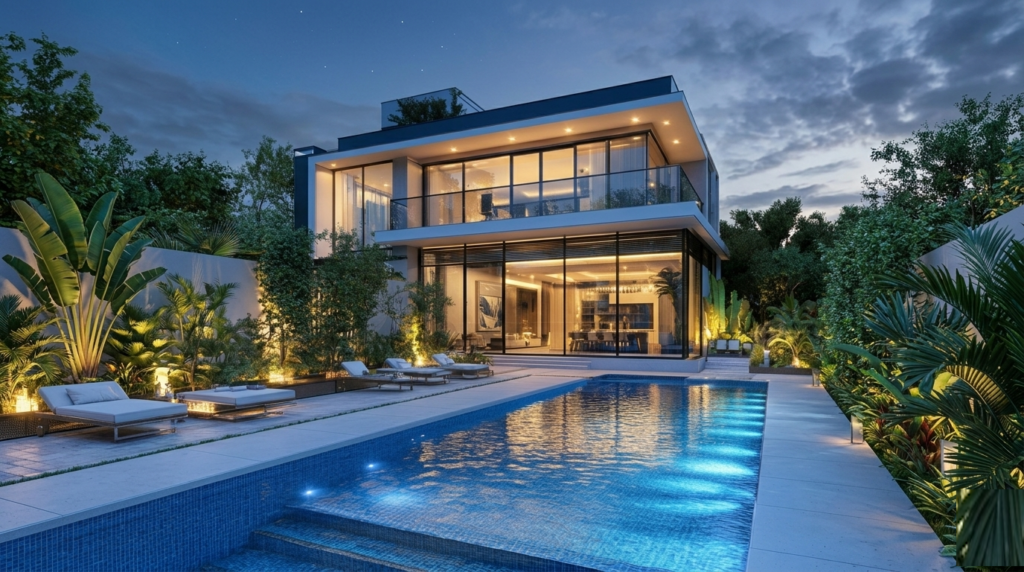
A green creation pool project in Dubai.
A heat budget for one ordinary pool
Take a common villa pool, 8 m long by 4 m wide, with an average depth of 1.4 m. These are round numbers on purpose, so you can change them for your own plot.
| Item | Working | Result |
|---|---|---|
| Water volume | 8 x 4 x 1.4 | 44.8 m3, about 45,000 litres |
| Surface area | 8 x 4 | 32 m2 |
| One centimetre of evaporation | 32 m² x 0.01 m | 320 litres |
| Heat carried away by that evaporation | 320 litres x about 0.67 kWh per litre | about 215 kWh |
| Warming the whole pool by 1°C | 45,000 kg x 4.19 kJ per kg per degree, divided by 3,600 | about 52 kWh |
| Cooling the pool by 3°C with a heat pump at COP 4 | 3 x 52 = 156 kWh of heat, divided by 4 | about 39 kWh of electricity |
| Flow for a 4-hour turnover | 45 m³ divided by 4 hours | about 11 m³ per hour |
Swipe the table sideways to see every column.
Look at the evaporation rows first. When a pool loses a centimetre of depth, it also loses about 215 kWh of heat, because turning water into vapour takes a lot of energy. On a hot, dry, windy day an uncovered pool can lose a centimetre or more. That is 320 litres to replace, and fresh top-up water that has to be rebalanced.
Evaporation works in both directions. In August it is the only thing stopping your water from being hotter than it is. In January it is what empties the heat out of the water overnight. Same physics, opposite results. That is why “always cover the pool” and “never bother with a cover” are both wrong, and why the cover, the shade and the heat pump are sized together.
What the numbers tell a buyer
- Cooling and heating are small compared with the heat that evaporation moves, so reducing evaporation is usually the cheapest first step.
- A heat pump with a COP of 4 delivers four units of heat for each unit of electricity. The COP falls on the hottest afternoons, so a sensible design adds margin.
- Ask any contractor to write the same table for your pool. If they cannot, they have not done the sums.
Water temperature targets are worth agreeing on in writing.
Targets differ by how the pool is used. These are common starting points we discuss with owners. The owner decides, and the design follows.
| Pool use | Common target | What it usually takes |
|---|---|---|
| Family pool in summer | 28-30°C | Shade, a chiller or a reversible heat pump in cooling mode, and nights left open so the water can shed heat |
| Family pool in spring and autumn | 26-28°C | Often nothing at all |
| Family pool in winter | 26-28°C | Heat pump, plus a cover overnight to hold the heat |
| Lap or training pool | 25-27°C | Careful cooling in summer, since swimmers generate heat too. |
| Children’s or shallow pool | 30-32°C | Heat pump and shade, because shallow water swings fastest |
| Spa or hot tub | 36-38°C | Dedicated heater, insulated cover and a separate circuit |
Swipe the table sideways to see every column.
Notice that the same pool can need a chiller in July and a heater in January. A reversible heat pump does both jobs with one unit, which is why it appears so often in our designs for villas. You can read more about the options on our page about pool heating and cooling in Dubai and a side-by-side view of what Dubai contractors recommend for pool heating.
Wind, orientation and where the pool sits on the plot
Wind is a quiet cost. Moving air carries vapour away from the water surface, so a pool in an exposed corner loses more water than the same pool behind a wall. The prevailing shamal wind in Dubai blows from the northwest, and when it picks up, it also brings dust. Dust goes straight into the water and lands on the filter.
Humidity matters too. Coastal plots are more humid, which slows evaporation but makes the heat feel heavier. Inland plots are drier, so water loss is higher and the air cools faster at night. Neither is better. They simply need different answers.
Site decisions that cut heat and water loss
- Put a screen, hedge or glass panel on the upwind side of the pool, usually the north-west.
- Keep the pool out of the narrow gaps between buildings where wind speeds up.
- Place the shade structure so it falls on the deck and the shallow end in the afternoon, when the sun is lowest and hardest.
- Think about where the plant room sits. It should be shaded and ventilated and away from bedroom windows.
- Fit a sub-metre on the top-up line. A sudden jump in water use is the earliest sign of a leak.
A simple bucket test separates evaporation from a leak. Fill a bucket, set it on the top step with its water level matching the pool, and mark both. Evaporation takes the same amount from each. A leak takes extra from the pool only. If you suspect a leak, our guide to detecting and repairing pool leaks in Dubai explains what to do next.
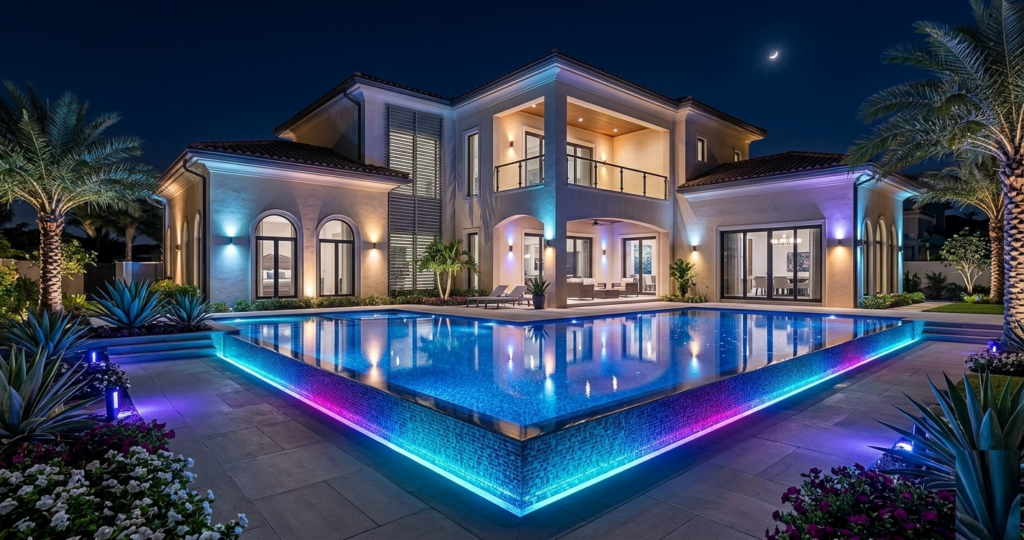
Deck, coping and water line on a completed Green Creation pool.
What heat does to the shell, the tile and the deck
Materials expand when they warm up, and a pool shell, a tiled wall and a stone deck all expand by different amounts. A specification that ignores this gives you hairline cracks and tiles that sound hollow when you tap them. The table below shows where heat does its damage and what a good specification says in response.
| Element | What heat does | What a good specification! |
|---|---|---|
| Structural concrete | Pours above about 32°C set too fast and can crack. | Early-morning pours, shaded materials, and curing started straight away. |
| Waterproofing membrane | Exposed edges degrade in direct sun before they are covered. | Protect and cover the membrane quickly, then flood-test before any tile goes on. |
| Pool wall and floor tile | Tile and shell move at different rates. | Movement joints, a flexible adhesive rated for heat, and tiles that do not craze |
| Grout | Soft top-up water and heat leach and soften it. | Polymer-modified or epoxy grout, depending on the finish |
| Deck stone | Dark stone in full sun can be too hot for bare feet | Light colour, honed or textured surface, and a sample left in the sun at 2 pm before it is approved |
| Pipework | UV makes exposed plastic brittle. | Pipes kept out of direct sun and clipped properly |
| Plant room | Enclosed rooms can run far hotter than the air outside. | Ventilation, shade, and clear space around the heat pump |
Swipe the table sideways to see every column.
Two of these are worth a closer look. First, the sample on the deck: put a piece of the proposed stone in the sun at 2 pm, then put your hand on it. It costs nothing, and it settles an argument that would otherwise cost money later. Second, the membrane. Waterproofing is the layer you cannot see once the tile is down, so it deserves a flood test with a witness. Our page on torch membrane waterproofing in Dubai goes into the method.
Tile choice is a heat decision too. Darker waterline tiles look good but absorb more sun, and glass mosaic reflects differently from porcelain. Our notes on pool tiling materials and what the best contractors specify and choosing pool tiles for colour and durability cover the trade-offs, and comparing pool construction materials for Dubai’s climate looks at the shell itself.
The plant room, pumps and hydraulics
The plant room is where a pool’s running cost is decided. A pool that looks the same on the outside can cost three or four times as much to run, depending on what is in this small room.
Turnover and the Dubai Municipality basics
Dubai Municipality guidance asks for the full pool volume to pass through the filter in about four hours, with at least one inlet for every 45 m³ of water. Private pools also need a barrier of around 1.2 m and an anti-entrapment drain design. Our pages on Dubai Municipality pool permits and pool permits and regulations explain the approval route, and pool safety standards cover barriers and drains. Confirm the current rules for your plot before you build, because community requirements can add to them.
Variable-speed pumps, with the arithmetic
Pump power falls with the cube of speed. Halve the speed and the flow halves, but the power drops to one-eighth. Run the pump twice as long, and the water still turns over the same number of times, for one quarter of the energy. Here is what that looks like for the 45 m³ pool.
| Setup | Power draw | Hours per day | Energy per day | Water moved per day. |
|---|---|---|---|---|
| Fixed-speed pump, 11 m³ per hour | 1.5 kW | 8 | 12 kWh | about 90 m³ |
| Variable-speed pump at half speed, 5.6 m³ per hour | 0.19 kW | 16 | about 3 kWh | about 90 m³ |
| Halogen pool light | 0.3 kW | 4 | 1.2 kWh | not applicable |
| LED pool light | 0.06 kW | 4 | 0.24 kWh | not applicable |
Swipe the table sideways to see every column.
The same water moved, one quarter of the electricity. Multiply the difference by your DEWA rate, and you can see how fast a variable-speed pump pays for itself. Lower flow also tends to filter better because the water spends longer in the sand. We cover the engineering in filtration system engineering and hydraulic flow rate assessment and the technology choices in choosing the right pool filtration technology.
Keeping the plant room alive
Pumps and controllers lose output when they run hot, and heat pumps do too. In a closed plant room in August, the air can be well above the outdoor temperature. Good design gives the room cross-ventilation, keeps it in shade, and leaves clear space around the heat pump so it does not breathe its own exhaust. Pump motors and electrical gear are also the first things to fail when a plant room overheats, which is why we run pump, motor and electrical diagnostics as part of the maintenance visit.
Cooling, heating and covers compared
| Option | How it works | What to expect | Watch for |
|---|---|---|---|
| Air-source heat pump, heating | Moves heat from the air into the water | Four to five units of heat per unit of electricity in mild weather | Needs airflow and a shaded, ventilated position |
| Reversible heat pump or chiller, cooling | Moves heat out of the water | Output drops on the hottest afternoons. | Size with margin, and make sure the pump runs at night. |
| Solar heating | Panels on a roof or frame warm the water | Good for winter and mid-season | Does nothing for summer cooling and needs roof space |
| Gas or LPG heater | Burns fuel to heat water quickly | Fast, but costs more to run than a heat pump | Fuel supply and storage rules for your community |
| Pool cover | Blocks evaporation and holds heat | Cuts most of the evaporation loss. | Needs a storage place and a person who will use it |
| Shade structure | Blocks direct sun on the water and deck. | Lowers water temperature and deck temperature. | Orientation matters more than size. |
Swipe the table sideways to see every column.
Which combination suits which owner?
A family villa with a plunge or small pool usually does best with a reversible heat pump, a variable-speed pump and shade over the shallow end. Owners who entertain at night often add LED lighting and a cover for the cooler months. Owners who use the pool mainly in winter and spring may skip cooling altogether and invest in a good cover and a heat pump for the cool months. Our notes on lap pools and plunge pools show how smaller pools behave, and infinity pools have a larger exposed edge and a balance tank, so they need more thought.
Hotels, resorts and residential developments run on a different scale. Water has to stay inside a narrow temperature band for guests at every hour, and plant sizes grow accordingly. Our work for developers and hospitality clients is described in commercial swimming pool construction in Dubai. For indoor and rooftop pools, the heat balance changes again, and we cover it in indoor pools and rooftop pools.
If saving energy is a priority from the start, read about energy-efficient pool solutions and green and sustainable pool design.
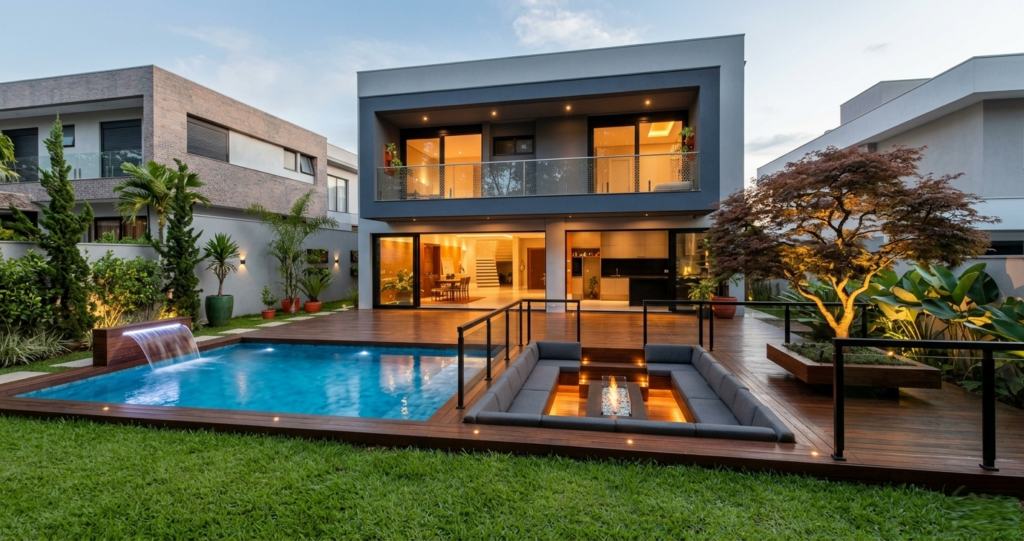
Water line, steps and deck finish on a Green Creation project.
Warm water changes the chemistry.
Warm water holds on to chlorine less well, and strong sun burns it off. Algae and bacteria grow faster as the temperature climbs. That means a pool that was easy to look after in March can turn cloudy in July without anyone changing a thing.
Evaporation also concentrates what is left behind. Stabiliser (cyanuric acid) stays in the water when vapour leaves, so levels creep up over a summer until the chlorine stops working properly. Top-up water in Dubai is desalinated and soft, so it is low in calcium. Adding a lot of it dilutes the hardness and can start to soften plaster and grout. Dust adds a physical load for the filter on top.
The usual working targets in Dubai are free chlorine of 1-3 mg per litre, pH between 7.2 and 7.8, total alkalinity of 80-120 mg per litre and very clear water. The sensible response is to test often and dose automatically, not to add chemicals by eye. Pages that go deeper on each point:
- Water chemistry management
- pH and alkalinity stabilisation
- Controlled chemical dosing
- Pool water testing and analysis
- Algae prevention
- A guide to pool water chemistry in Dubai
- Saltwater pools in Dubai
Automatic dosing with a pH and ORP probe takes some of the guesswork out of summer, and it is easier to design into a new pool than to add later. Smart pool technology explains what automation can and cannot do.
A year of heat, month by month
A pool has a different job in each part of the year. This calendar is how we think about the work, and it is a useful checklist for owners.
| Months | What the pool is doing | What to do |
|---|---|---|
| December to February | Water drifts towards 20°C, nights are cold, and evaporation is low. | Heat pump on a timer, cover on at night, clear dust from the heat pump coil |
| March and April | Pleasant weather, and algae starts to wake up. | Re-test the chemistry, clean the filter, and service the pump. |
| May and June | Heat builds fast, and the water warms quickly. | Switch to cooling, check the shade, and test the stabiliser before it climbs too high. |
| July to September | Peak heat, highest chlorine demand, highest evaporation | Check the plant room temperature, run the pump at night, and test water more often. |
| October and November | Cooling air and a lot of summer dust | Deep-clean the filter, inspect the tile and grout, and test the heat pump before winter. |
Swipe the table sideways to see every column.
Commercial pools shift this pattern. Hotels and clubs keep a strict temperature band all year and test water several times a day, so their plant works hard every month.
Heat mistakes we see again and again
These come up on site visits and repair calls more than any others. Each one is cheap to avoid at the design stage and expensive to fix later.
- Choosing a pool by size and finish only, and leaving heating and cooling for “later”. ‘Later’ usually means a heat pump with nowhere sensible to sit.
- Accepting a fixed-speed pump because it makes the quote smaller. The saving disappears within a couple of summers.
- Picking dark, polished deck stone from a catalogue photo and finding out in June that nobody can walk on it.
- Squeezing the heat pump into a corner with no airflow, so it breathes its own warm exhaust and loses output.
- Building a plant room with no ventilation. Pumps, controllers and sensors fail early when the room runs hot.
- Leaving the shallow end in full afternoon sun, then wondering why the water there is the warmest in the pool.
- Skipping the flood test on the membrane. A leak behind finished tile is the most expensive repair in the trade.
- Topping up with a hose and no meter, so a slow leak runs for months before anyone sees it.
- Switching the pump off in summer to save electricity. Warm, still water turns green within days.
Several of these lead to repair work, and our page on common pool problems in Dubai and how to avoid them explains how they show up. Construction mistakes to avoid cover the building side.
Shade, planting and the pool as one project
Green Creation started as a landscaping company before it built pools. That history shapes how we plan a plot. The pool, the deck, the shade and the planting get designed together, because they act on each other all day long.
- Trees and shade structures change how much sun reaches the water, and the right choice depends on the time of day.
- Some plants drop leaves, fruit or fronds into the pool, which loads the skimmers. Others are perfect for a screen on the upwind side.
- Irrigation overspray that lands in the pool adds nutrients and hardness to the water. Sprinkler heads should point away from the edge.
- Hard surfaces around the pool store heat. Planting beds and light-coloured decking keep the whole area cooler.
Our pages on integrating the pool with the garden, planning a garden from concept to creation and transforming Dubai gardens show finished examples. For design ideas see pool design in Dubai and luxury pools in Dubai.
How heat and wind differ by type of plot
The same specification does not suit every community. These are general patterns we see across our work, not rules.
- Coastal plots, such as parts of Palm Jumeirah and the marina areas, get sea breeze, salt in the air and higher humidity. Equipment needs corrosion protection and the wind screen matters.
- Inland villa communities, such as Arabian Ranches, Dubai Hills and Jumeirah Village Circle, get dry heat and more dust. Evaporation is higher and filtration works harder.
- Older plots in areas like Al Barsha often have mature walls and trees. Those give shade and shelter, but roots and overhanging branches need watching.
- Podium and rooftop pools sit in full sun and wind with no ground to absorb heat. Structure, drainage and weight come first, then heat.
Our overview of the best residential communities for private pools is a useful companion.
What to ask to see at handover
Handover is the last point where a contractor has every reason to answer questions. Ask for these, and keep copies.
- The measured flow at the pump and the pump curve for the model installed.
- The current draw of the pump, and the controller settings for each speed.
- The heat pump or chiller model and commissioning record, with the water temperature before and after a test run.
- The flood-test record for the shell, signed by someone who watched it.
- The plant room temperature at the hottest part of the day, if you can take it.
- Operation and maintenance manuals for every piece of equipment.
- The written warranty, with what it covers and for how long.
- The name of the person who will service the pool, and the date of the first visit.
This is also the moment to sign up for care. A pool that goes straight from construction into a weekly service plan keeps its first-year records in one place.
Ten questions that test a pool contractor on heat
Put these to every firm on your shortlist, including us. The answers tell you more than a brochure does.
- What water temperature should I expect in August, and in January, with the design you are proposing?
- Can you show me the heat budget for my pool, the same kind of table as the one above?
- Which pump are you specifying, and is it variable-speed? What is its power draw at low speed?
- What size is the heat pump or chiller, what is its COP, and where will it sit?
- How will the plant room be ventilated and shaded?
- Which stone and tile are going on the deck and waterline, and can I see a sample in the sun?
- How is the membrane protected between laying and tiling, and who witnesses the flood test?
- What automation or dosing is included, and what is left for me to do by hand?
- Who looks after the pool after handover, and what do they check at the annual review?
- What does the written warranty cover, and for how long?
More questions of this kind appear in critical questions to ask before hiring a contractor, questions every client must ask and what to know before signing any contract.
Running-cost arithmetic you can do yourself
Dubai electricity tariffs change, so we show kilowatt-hours rather than dirhams. Multiply by your current DEWA rate and you have a number you can trust. These figures come from the 45 m3 example earlier on this page.
| Running item | Daily energy | Notes |
|---|---|---|
| Fixed-speed pump, 8 hours | 12 kWh | Same water turned over as the variable-speed option |
| Variable-speed pump, 16 hours at half speed | about 3 kWh | About 75 percent less |
| Halogen light, 4 hours | 1.2 kWh | One fitting only |
| LED light, 4 hours | 0.24 kWh | About 80 percent less |
| Cooling 3°C once, heat pump at COP 4 | about 39 kWh | Only on days when the pool needs it |
| Replacing one centimetre of evaporation | 320 litres of water | Also needs rebalancing |
Swipe the table sideways to see every column.
The biggest saving in this table comes from the pump, which runs every day all year. The second comes from cutting evaporation. Heat pump running costs matter, but they are seasonal. When you compare two quotes, ask for these figures on both. The cheaper quote is sometimes the dearer pool. For a wider look at construction pricing, see the cost of building a swimming pool in Dubai and ways to reduce pool maintenance costs.
Why Green Creation

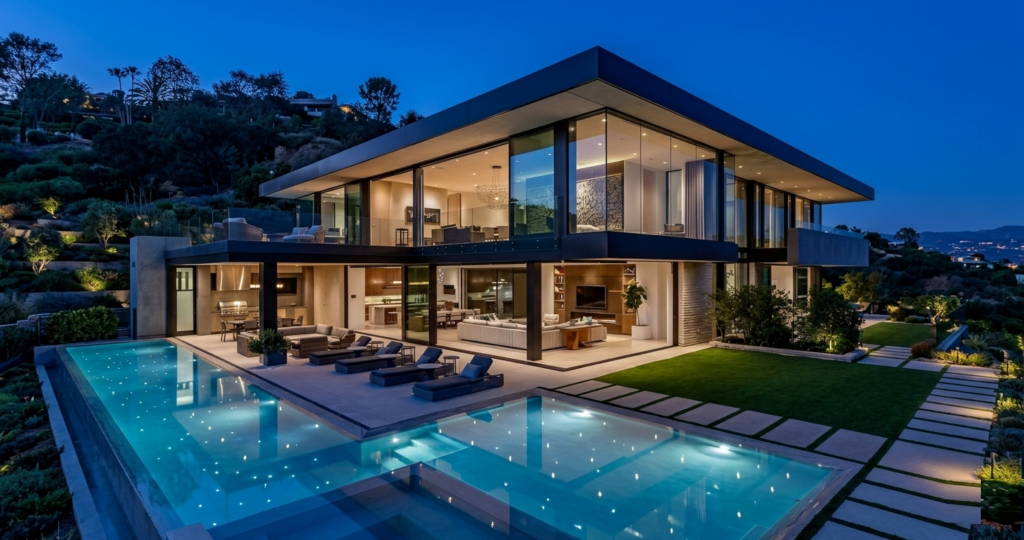
Another finished pool by Green Creation in Dubai.
Looking after the pool once it is handed over
A good design only helps if somebody looks after it. Filters clog with dust faster in summer, sensors drift, and a heat pump coil collects dirt. We pair every build with a maintenance plan that matches how the pool is used.
- Residential and villa pool maintenance, with weekly cleaning where it makes sense.
- Commercial pool maintenance for hotels, clubs and communities.
- Preventive maintenance planning and environmental maintenance for the local climate.
- Filter media maintenance and structural and surface integrity checks.
- Compliance checks, so records and equipment match what the authorities expect.
An annual maintenance contract also gives you one team that knows your pool’s history. For seasonal guidance see preparing a pool for Dubai’s harsh summer, top tips for a hot climate and the seasonal checklist.
Improving an existing pool for heat
You do not need a new pool to get most of these gains. The most common upgrades on older pools are, in order of payback:
- A variable-speed pump in place of a fixed-speed one.
- LED lighting in place of halogen.
- A cover, or a shade structure over the shallow end.
- A reversible heat pump where only a heater, or nothing, was fitted.
- Dosing and probes, so chemistry stays steady in summer.
- New tile, grout or deck stone if the existing surfaces are failing.
When the shell, the pipework or the tile has started to fail, repair comes first. Our pages on swimming pool repair, fixing leaks, cracks and equipment faults and when and how to renovate explain the sequence.
Planning your own project
Start with the temperature you want, then work backwards to the equipment. Write the targets down, pick a heating and cooling plan, choose surfaces you can stand on in summer, and ask for the numbers from each contractor. Our guides to planning a pool step by step, the construction process and construction from concept to completion cover the stages, and the ultimate buyer’s guide helps with budgets.
If you want to see what we have built, the project gallery has recent work, and our services page lists everything we do. For a closer look at the engineering behind our work, read our flagship guide to swimming pool construction Dubai projects, written around design precision and long-term performance.
Further reading from Green Creation
Related pages on our site, grouped loosely by topic.
Choosing a contractor
- Essential criteria for choosing a contractor
- How to choose the best swimming pool contractor
- Pool contractors in Dubai: an expert buyer’s guide
- What sets the best construction companies apart
- Swimming pool companies in Dubai
- Evaluating customer feedback
- Avoiding common pitfalls when hiring
Design and features
- Luxury pool design trends and technology
- Water features
- Choosing the right pool shape
- Smart technology for pool management
- Sustainable pool designs
- Eco-friendly pool construction
- Energy-efficient solutions by leading contractors
Pools of every kind
- Swimming pool Dubai
- Swimming pools Dubai
- Swimming pool in Dubai
- Pools Dubai
- Premium custom pools by Green Creation
Care and repair
Frequently asked questions
How hot does a swimming pool get in Dubai in summer?
An uncooled, unshaded villa pool commonly reaches the low to mid 30s °C in August. Shade, a cover used correctly and a chiller or reversible heat pump can bring it down to a more comfortable 28-30°C. The exact figure depends on depth, sun exposure and wind.
How do I choose between swimming pool contractors in Dubai?
Compare them on the same numbers. Ask each firm for a heat budget, the pump and heat pump specification, a sample of the deck stone, a written scope and the warranty terms. Visit a finished pool built by each one, and speak to an owner. Our guide to choosing the best swimming pool contractor walks through the steps.
What should swimming pool construction companies in Dubai include in a quote?
A good quote lists the shell method, the waterproofing, the filtration and pump model, the heating or cooling equipment, the finishes, the permits, the commissioning and the warranty, each with a cost. Provisional sums should be clearly marked. See what to know before signing a contract.
Is a heat pump worth it for a Dubai pool?
For most villa pools used in winter, yes. A heat pump delivers four to five units of heat for each unit of electricity, which makes it cheaper to run than most other heaters. A reversible model also cools in summer. It needs a shaded, ventilated position and some design margin for the hottest afternoons.
Does a pool cover make sense in a hot climate?
Yes, used at the right times. A cover cuts evaporation and holds heat on winter nights, so it saves water and heating energy. In summer, leaving the pool open at night lets it shed heat. Many owners use a cover in the cooler months and shade in the hot ones.
How much water does a pool lose to evaporation in Dubai?
It depends on wind, humidity, water temperature and shade. As a guide, one centimetre of lost depth on an 8 m by 4 m pool is 320 litres. On a hot, dry, windy day an uncovered pool can lose a centimetre or more. A bucket test can tell you whether a drop in level is evaporation or a leak.
How long does it take to build a swimming pool in Dubai?
It varies with size, access, approvals and finishes. Design and approvals often take several weeks before any digging starts, and construction follows in stages: excavation, shell, waterproofing, pipework, tile, equipment and commissioning. A written programme from your contractor is the best answer for your plot. See our guide to the pool construction process.
Do I need approval to build a pool at my villa in Dubai?
Yes. Pool plans need approval from the relevant authority, and many communities also need a no-objection certificate from the master developer. The route depends on the location of your plot. Read our guide to Dubai Municipality pool permits before you start.
What is a variable-speed pump and why does it matter?
A variable-speed pump can run slower than full speed. Because power falls with the cube of speed, running at half speed uses one eighth of the power, and running twice as long still moves the same amount of water for about one quarter of the energy. It also runs more quietly and filters well.
What deck material stays coolest in the Dubai sun?
Light-coloured, honed or textured stone and some porcelain products stay cooler underfoot than dark, polished surfaces. The best test is to leave a sample in direct sun at 2 pm and touch it. Ask your contractor for samples before you approve a finish.
Can you build and maintain my pool?
Yes. Green Creation builds new pools, repairs and renovates old ones, and runs maintenance plans for villas and commercial sites. Our divers can work on a pool without draining it. See our full list of services.
What chemical levels should a Dubai pool keep?
Common working targets are free chlorine of 1-3 mg per litre, pH between 7.2 and 7.8 and total alkalinity of 80-120 mg per litre. Stabiliser levels should be watched, because evaporation concentrates it over summer. Read more in our guide to pool water chemistry in Dubai.
Why does my pool turn green in summer?
Warm water, strong sun and low chlorine let algae grow quickly. Poor circulation, dirty filters and high stabiliser levels make it worse. Fixing it means correcting the chemistry, cleaning or backwashing the filter and brushing the surfaces. Prevention is easier, and our page on algae prevention explains how.
How often should a pool in Dubai be serviced?
Most villa pools are serviced weekly, with extra visits in peak summer or after dust storms. Commercial pools usually need daily checks. A good cleaning service also keeps records you can show an inspector.
Can an old pool be made more energy-efficient?
Usually yes. The most common upgrades are a variable-speed pump, LED lights, a cover or shade, a reversible heat pump and automatic dosing. Repair any leaks or cracks first. Our pages on renovation and repair explain the order.
How can I contact Green Creation?
Call +971 50 948 4081 between 9 am and 6 pm, or visit our About page for more details. We are happy to visit the plot, discuss temperature targets and quote against the same specification as any other firm.
Ready to compare pool quotes on the same numbers?
Call Green Creation on +971 50 948 4081, 9 am to 6 pm, and bring your plot, your target water temperature and your questions.
The worked examples use an 8 m by 4 m pool with an average depth of 1.4 m. They are engineering arithmetic, not a quotation. Targets and rules should be confirmed against current Dubai Municipality and community requirements for your plot.