
Swimming pool contractors in Dubai and what the ground beneath your villa decides
Most pool quotes in Dubai read the same. Same shell thickness, same tile allowance, same twelve-week promise. What almost none of them mention is the one thing that actually decides whether that pool is still watertight in five years: what is sitting under your plot before anyone breaks ground.
Green Creation has been building, repairing and maintaining pools across the emirate long enough to know that the contract clauses and glossy renders matter less than the geotechnical reality beneath them. This guide walks through that reality, what it means for swimming pool construction in Dubai, and why it is the reason to choose a pool builder who takes the ground as seriously as the tile colour.
What’s in this guide?
- What Dubai’s ground actually does to a pool
- Why the survey happens before the drawing
- Choosing a shell method that matches the site
- Waterproofing and the flood test that proves it worked
- The build, stage by stage
- Dubai’s water is not neutral either
- Why Green Creation builds this way
- The same city, different ground: a few examples
- Dubai Municipality rules that hold whatever contractor you pick
- What it costs, roughly, and why ranges vary so much
- Choosing a contractor: the questions that matter
- After handover: keeping the shell you paid for
- Frequently asked questions
Short answer
A pool built in Dubai must survive gypsum-bearing soil, a water table that can sit within a few metres of the surface near the coast, and top-up water that is almost calcium-free and desalinated. A contractor who designs around those three facts, rather than around a standard concrete shell drawing, is the one whose pool is still level and leak-free a decade later. That is the difference this guide is really about.
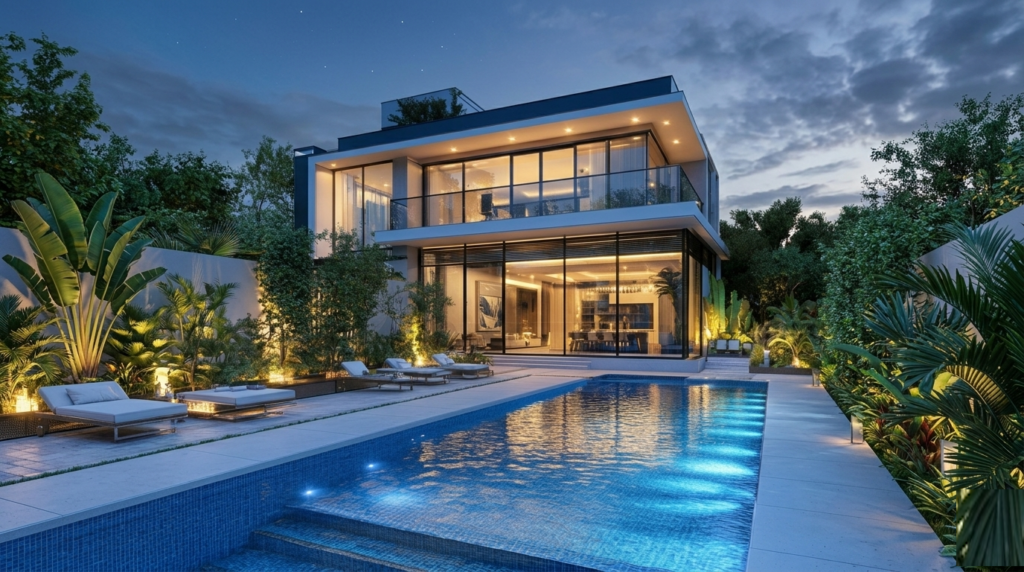
A shell is going in on a Dubai villa plot, with reinforcement tied before the pour.
What Dubai’s ground actually does to a pool
Dubai sits on a mix of aeolian sand, marine deposits and sabkha, a salt-crusted ground type common along the Gulf coast that carries gypsum and other soluble salts. None of that is exotic information to a geotechnical engineer, but it rarely makes it into a homeowner’s pool conversation, and it should.
Three things follow from it.
Sulphate and chloride attack concrete faster here.
Gypsum and dissolved salts in the ground react with ordinary Portland cement over time, and the same salts accelerate corrosion of any reinforcement steel they reach. A pool shell built with standard-grade concrete and the minimum cover to steel will show it within a handful of years, usually as rust staining bleeding through the render or hairline cracking along the waterline. The solution is a sulphate-resisting cement blend, adequate concrete cover, and a waterproofing membrane that is doing real work rather than sitting there as a formality.
The water table varies and is not always deep.
In coastal and low-lying pockets of Dubai, groundwater can sit within a few metres of natural ground level, closer still after heavy rain. Excavate a pool basin in that setting and dewater it during construction, and if the pool is later emptied for any reason, an uncontrolled water table pushing up from below can lift an unballasted shell clean out of the ground. Pool builders call this hydrostatic uplift. It is why a competent contractor asks about groundwater before excavation starts, not after a shell has already floated.
Fine desert dust is a filtration load, not a housekeeping problem.
The dust that settles on every outdoor surface in Dubai within days is fine enough to pass through a lightly maintained filter and cloud the water rather than being trapped. Pools here need filtration sized and serviced for that reality, not for the lighter dust load a European or American design guide assumes.
Why the survey happens before the drawing?
A design-first contractor sketches the pool, prices it, and worries about the ground once the excavator turns up. A ground-first contractor does the opposite: a geotechnical check of the plot, including a read on the water table and the soil profile at pool depth, before a single structural drawing is signed off.
What that survey decides, in order: the shell method; the depth of dewatering needed during construction; whether the base slab needs extra ballast against uplift; the concrete grade and cement type; and where the plant room can sit without fighting the site’s drainage fall. Skip the survey, and every one of those becomes a guess dressed up as a standard specification.
This is also where Green Creation’s landscaping background does more than it looks like on paper. The company started as a landscaping business before adding pool construction, and a garden and pool designed together share drainage, retaining structures and planting loads in ways that matter to how the ground behaves around the shell. Two separate contractors handing off a half-finished site to each other rarely coordinate that well. Read more about who Green Creation is and how that combination came about.
Choosing a shell method that matches the site
There is no single correct shell method for a Dubai pool. There is a correct method for a given plot, budget and water table reading.
| Shell method | Where it fits | Ground sensitivity |
|---|---|---|
| Cast in-situ reinforced concrete | Custom shapes, most villas and commercial pools | Needs correct cover, sulphate-resisting cement, and uplift ballast on high water table sites. |
| Shotcrete or gunite | Free-form and vanishing-edge designs | Sensitive to curing conditions and rebound quality control |
| Fibreglass shell | Faster residential installs, standard shapes | Lighter shell, more exposed to uplift unless properly anchored |
| Block and render (masonry) | Smaller budgets, simple rectangular pools | Weakest against ground movement and salt attack without a strong membrane |
| Stainless steel or panel systems | Commercial and architectural finishes | Ground-tolerant structurally, but sub-base drainage still has to be right. |
Swipe the table sideways to see every column.
A contractor optimises for their own workflow, not for the pool’s lifespan, by offering the same method for every job regardless of site conditions. Explore examples of finished work across shell types in the project gallery.
Waterproofing and the flood test that proves it worked
Waterproofing absorbs most of the ground-related risk, and it is also where corners are most often cut, because a bad membrane job looks identical to a good one until the pool has been full of water for a season.
The sequence that actually protects a shell: apply the membrane system to a clean, cured substrate, detail every penetration (main drain, returns, lights, skimmer) rather than relying on the flat membrane to cover them, and then flood-test the shell before a single tile goes down. A proper flood test holds water in the shell for at least twenty-four hours, often longer, and the level is marked and re-checked rather than eyeballed. If the level drops beyond what evaporation alone explains, the leak gets found and fixed while the shell is still open, not two years later when it means draining a finished pool and breaking tiles to get at the membrane.
This single step is the clearest divide between contractors who build for the warranty period and contractors who build for twenty years. For a more profound look at what happens when it goes wrong, see how to detect and repair pool leaks in Dubai and swimming pool repair.
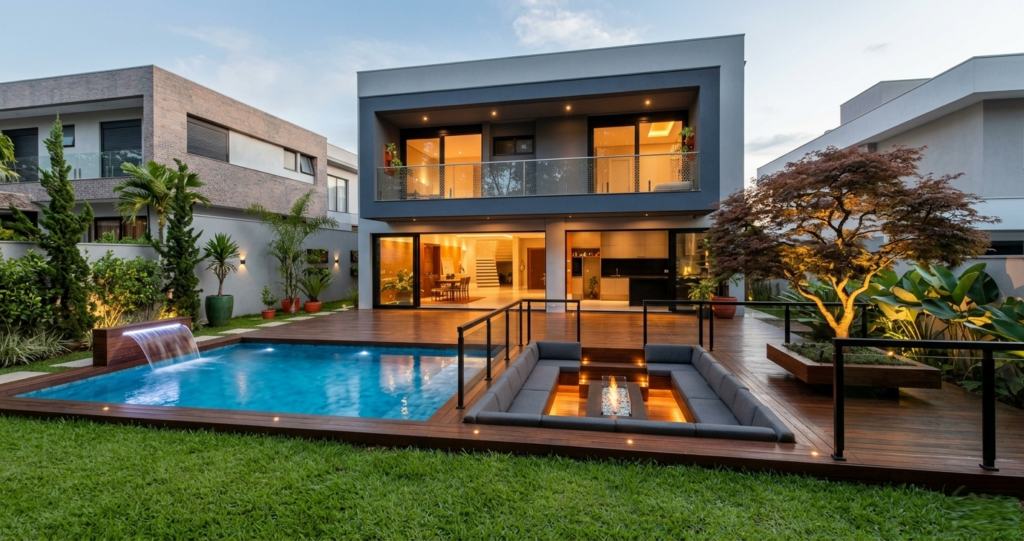
Membrane detailing around a penetration point is the step most often rushed on a tight schedule.
The build, stage by stage
| Stage | What happens | What can still change |
|---|---|---|
| 1. Survey and design | Geotechnical check, structural and hydraulic drawings, permit submission | Shape, depth, equipment selection |
| 2. Excavation | Dig to shell depth plus working margin, and dewater if the water table requires it. | Access route, spoil removal method |
| 3. Steel and formwork | Reinforcement tied to the structural drawing, shuttering set | Nothing structural; this is now locked. |
| 4. Plumbing and electrical rough-in | Circulation pipework, main drains, lighting conduits, and bonding are installed. | Fitting positions if flagged now |
| 5. Concrete pour | Shell poured in the specified grade, cured under cover | Nothing; the shell is fixed geometry from here. |
| 6. Waterproofing and flood test | Membrane applied, penetrations detailed, shell held full of water and checked | Any leak found here is still cheap to fix. |
| 7. Tiling and coping | Finish materials set with movement joints, coping laid to fall | Tile and coping selection |
| 8. Deck and surrounds | Deck poured or paved to shed water away from the shell, landscaping tied in | Deck material, planting, lighting layout |
| 9. Plant room and equipment | Pump, filter, heater and dosing equipment installed and wired | Automation level, energy-efficient upgrades |
| 10. Commissioning | System run under load, turnover rate measured, water balanced | Fine-tuning only |
| 11. Inspection and handover | Authority sign-off where required, documentation and warranty handed to the owner | None |
| 12. First service visit | Scheduled within the first weeks to catch anything that settles in after use begins | A maintenance plan is chosen at this point. |
Swipe the table sideways to see every column.
Notice how narrow the “what can still change” column becomes after stage five. That is deliberate. A pool’s real quality is decided in the first six stages, well before there is anything attractive to look at, which is precisely why so many buyers judge a contractor on the wrong things.
Dubai’s water is not neutral either.
Once a pool is built correctly, the water going into it keeps working on the shell, the grout and the equipment. DEWA’s desalinated supply is excellent drinking water but arrives with very little natural calcium hardness. Water that is too soft pulls calcium out of anything it touches to find equilibrium, which over time can etch plaster and leach grout lines. DuDubai’s evaporation rate, among the highest anywhere, also concentrates whatever stabiliser and salts are already in the water, which is why a pool topped up carelessly through summer can end up with chlorine that stops working properly, even though the reading looks fine on paper. One of these is difficult to manage. It just has to be measured rather than assumed. A proper water-testing routine checks calcium hardness and cyanuric acid alongside the usual chlorine and pH and adjusts the balance rather than just adding more chlorine when the water looks cloudy. Related reading: pool water testing and analysis, water chemistry management, and pH and alkalinity stabilisation.
Watch out.
A pool that looks clear is not the same as a pool that is chemically balanced. Cyanuric acid build-up from years of stabilised chlorine can lock the sanitiser at a reading that appears normal on a basic test strip, while the chlorine has almost no disinfecting power left. This is one of the more common and least visible problems in villas that have been topped up the same way for a few summers without a full lab test.
Why Green Creation builds this way
Green Creation has operated in the UAE for more than twenty years, across 8,940 completed projects for over 5,500 clients, including work for names like Emaar, Meraas, Sobha, Deyaar and Hilton. The company works both as a turnkey contractor, taking a project from empty plot to finished pool, and as a specialist subcontractor to main contractors on larger developments, which means the same ground-first process applies whether the client is a homeowner in Al Barsha or a main contractor on a hotel job.
Every design detail and cost component is agreed directly with clients and their architects rather than handed over as a fixed package, which is especially important at the stage this guide has focused on most: deciding the shell method, the waterproofing spec and the ballast requirement before the drawing is finalised, not after a problem shows up.
What that looks like after handover
Green Creation’s maintenance division includes in-house commercial divers who are qualified pool engineers, able to inspect and repair a pool underwater without draining it, which matters directly to the ground conditions covered above: An unnecessary drain-down is exactly the situation that puts an empty shell at risk from hydrostatic uplift on a high water table site. Every maintenance relationship starts with a pool audit, including a fill-water test, before any service plan or quote is agreed, and an annual review covers pump curve performance, filter integrity, and controller calibration rather than just a quick visual check.
The company also services hot tubs, saunas and steam rooms alongside pools and covers residential communities including Palm Jumeirah, Arabian Ranches, JVC, Dubai Hills and Al Barsha, along with commercial and hospitality work up to Olympic-sized pools. Explore the full range of services, or go straight to residential, commercial and villa pool maintenance.
- Turnkey construction
- Subcontractor to main contractors
- Landscaping and pool combined
- Commercial diver maintenance
- Villa to Olympic-sized commercial
- Hot tubs, saunas and steam rooms
The range of pools this same ground-first approach covers
The site conditions described above apply whatever style of pool sits on top of them, but the finish and equipment specification change a great deal by pool type.
- Infinity and vanishing-edge pools, where the edge detail depends heavily on a level, well-compacted base
- Lap and plunge pools for smaller plots and townhouse gardens
- Indoor pools, where ventilation and dehumidification take on the role outdoor evaporation otherwise plays
- Rooftop pools, where structural loading replaces ground bearing as the main engineering question
- Commercial pools for hotels, resorts and residential developments, built to public bathing turnover rates
- Luxury custom pools combining several of the above with water features and lighting design
Related design reading: pool design in Dubai, top luxury pool designs for homes in Dubai, swimming pool water features, and integrating a pool with the garden.
The same city, different ground: a few examples
Dubai is not one uniform site condition, which is precisely why a survey beats a standard specification sheet.
Palm Jumeirah and other reclaimed coastal developments sit on placed and compacted marine sand, generally with a shallow water table close to sea level, making uplift risk and salt exposure a routine part of any pool design there rather than an edge case. Inland communities such as Arabian Ranches, JVC and much of Dubai Hills sit further from the coast, often with a deeper water table, though local pockets of sabkha and gypsum-bearing soil still turn up and only a site-specific check will catch them. Villas in older, established areas like Al Barsha can carry an added wrinkle: mature trees and long-settled soil close to the plot boundary, which changes how excavation and shoring near the property line gets planned.
High-rise developments around Downtown and Business Bay bring a different problem entirely. A podium-level pool is not sitting on native ground at all; it is sitting on a structural slab, so the “ground condition” question becomes a structural loading and waterproofing-to-the-building-below question instead. The lesson carries either way: know what your pool is actually resting on before treating any construction quote as final.
Dubai Municipality rules that hold whatever contractor you pick
Ground conditions decide how a pool survives. Regulation decides whether it gets approved and stays legal to operate. Some of the technical rules that apply across Dubai, regardless of who builds the pool:
| Rule area | Requirement |
|---|---|
| Water turnover | Full pool volume is filtered within a set turnover period, commonly around four hours for private pools. |
| Inlets | Minimum one inlet per roughly 45 cubic metres of water to keep circulation even |
| Barrier height | A pool barrier or fence of at least 1.2 metres where child safety rules apply |
| Deck fall | The surrounding deck is graded to fall away from the pool, typically around 1:40, so surface water and chemicals do not run back in. |
| Anti-entrapment | Drain covers and suction outlets are designed to prevent entrapment, with dual drains on larger pools. |
| Design changes | No structural changes are permitted once a permit is issued without a fresh submission. |
Swipe the table sideways to see every column.
Further reading: a comprehensive guide to pool construction regulations in Dubai, Dubai Municipality pool permits, swimming pool permits and regulations, swimming pool compliance, and swimming pool safety standards.
What it costs, roughly, and why ranges vary so much
Two pools of the same surface size can carry very different price tags once ground conditions are accounted for. A site with a shallow water table and gypsum-heavy soil needs deeper foundations, more concrete cover, uplift ballast and a thicker waterproofing membrane than a site sitting on stable, well-draining ground, even if both pools measure the same eight metres by four.
| Pool type | Typical range, standard finish | What pushes it higher |
|---|---|---|
| Plunge pool | Lower end of the market | Difficult access, high water table site |
| Standard villa pool (around 8×4 m) | Mid-range | Vanishing edge, natural stone finish, automation |
| Lap pool | Mid-range, driven by length | Counter-current systems, heating |
| Infinity or vanishing-edge pool | Upper-mid- to high-end | Balance tank engineering and structural support for the edge. |
| Commercial or hospitality pool | Project-priced individually | Public turnover standards, accessibility features, bather load |
Swipe the table sideways to see every column.
Please consider any quote received before a site survey as provisional. A firm number that never moves once the ground is actually inspected is usually a sign the survey never happened, not a sign of confidence. For a fuller breakdown, see our guide on understanding the costs associated with swimming pool installation in Dubai, including a cost comparison between budget and high-end pools. budget and high-end pools.
Choosing a contractor: the questions that matter
Most buyer guides list generic questions about licensing and portfolio. Those matter, but they will not tell you whether the contractor in front of you actually accounts for the ground. Ask these instead.
- Will a geotechnical or water table check happen before the drawing is finalised, and who carries it out?
- What cement type and concrete grade is specified, and does it change based on soil salinity readings?
- Is there a dewatering plan for excavation and a ballast plan if the water table is shallow?
- Is a witnessed flood test included before tiling, or is waterproofing simply applied and covered?
- Who owns the plant room commissioning, and is the turnover rate actually measured rather than assumed from the pump’s rated flow?
- Does the licence activity line actually name pool or building contracting work, not just landscaping or general trading?
That last point is worth pausing on. A surprising number of firms advertising pool construction in Dubai hold a trade licence whose activity line covers landscaping, gardening or general contracting rather than pool or building construction specifically. It is worth asking to see the licence activity line directly rather than assuming a company website implies it.
Red flags worth walking away from
A quote issued with no site visit at all. A contractor who cannot describe their shell method beyond “concrete”. No mention of a flood test anywhere in the contract. Payment schedules front-loaded so most of the money changes hands before the shell is even poured. Any of these on their own is a reason to ask more questions; two or more together is a reason to look elsewhere.
After handover: keeping the shell you paid for
A well-built shell can still be undone by poor maintenance, and in Dubai’s climate the timeline for that is shorter than most owners expect. Evaporation, dust load and desalinated top-up water do not pause once the contractor leaves the site.
A sound maintenance routine covers cleaning, water testing and balancing, equipment checks and periodic deeper inspection, ideally from the same standard the pool was built to rather than a generic weekly skim. Related services: professional pool maintenance, weekly pool cleaning, swimming pool cleaning, quality swimming pool maintenance, preventive maintenance planning, and reducing pool maintenance costs.
On the technical side: structural and surface integrity checks, pump motor and electrical diagnostics, hydraulic flow rate assessment, filter media maintenance, filtration system engineering, controlled chemical dosing, and algae prevention.
Two more are worth knowing about specifically because of everything covered above: environmental factors in Dubai pool maintenance, which walks through dust, heat and evaporation in more detail, and saltwater pool repair, relevant to the growing number of villas switching to salt chlorination.
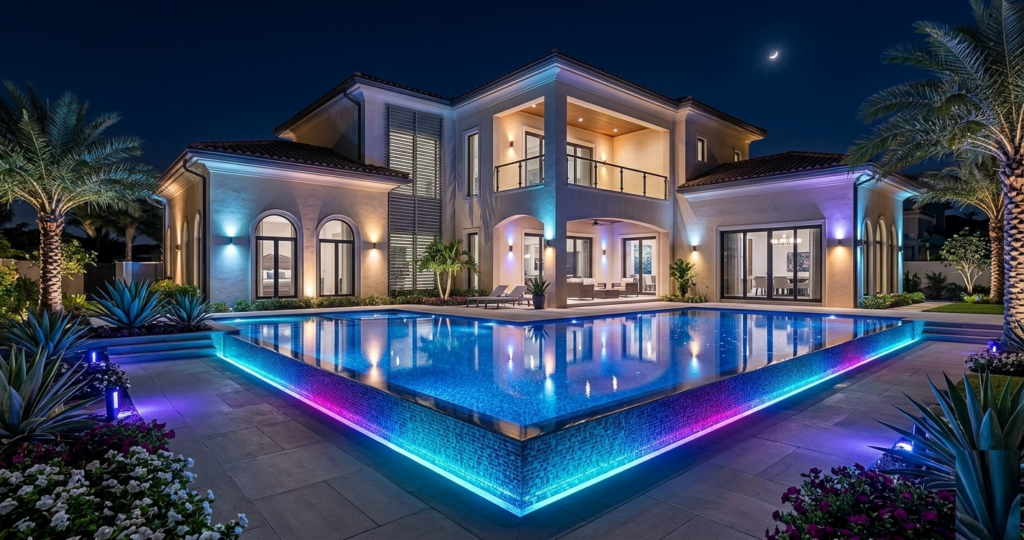
The pool and landscaping are finished as one project rather than two separate contracts.
Where the equipment side is heading
None of the ground-level detail above stops a pool from also being genuinely modern to run. Variable-speed pumps cut energy use compared with fixed-speed units by matching output to the turnover actually required at each time of day. Inline dosing systems hold pH and sanitiser within a tighter band than manual dosing ever manages, which matters more here given how fast evaporation concentrates whatever is already in the water. Salt chlorination, robotic cleaners, app-based automation and pool covers that cut evaporation all reduce the day-to-day workload on an owner, but none of them compensate for a shell that was built without accounting for the ground it sits in. Explore this in more depth at Smart Pool Technology in Dubai and why more homeowners are switching to saltwater pools.
Talk to a pool builder who checks the ground first.
Call +971 50 948 4081, nine in the morning to six in the evening, or send over your plot details, and let’s start with a proper survey.
Frequently asked questions
Why does the water table matter so much for a Dubai swimming pool?
A shallow water table can push up against an empty or partly built shell with enough force to lift or crack it, a problem called hydrostatic uplift. Sites near the coast or in low-lying areas need this checked before excavation and often need extra ballast or a relief system built into the design.
Does every plot in Dubai have this problem?
No. Ground conditions vary a great deal even between neighbouring plots. That is exactly why a site-specific survey matters more than a generic soil report for the general area.
What is sabkha, and why does it come up in pool construction?
Sabkha is a salt-crusted ground type common along the Gulf coast, carrying gypsum and other soluble salts that can attack ordinary concrete and reinforcement steel over time. Builders working on or near it use sulphate-resisting cement and correct steel cover to protect against it.
How long should a flood test hold water before tiling starts?
A common standard is at least twenty-four hours, sometimes longer on larger or more complex shells, with the water level marked and checked against expected evaporation rather than just glanced at.
Why is desalinated tap water an issue for pools?
DEWA’s desalinated supply carries very little natural calcium hardness. Water that stays too soft for too long can pull calcium out of plaster and grout to find balance, so calcium hardness needs checking and adjusting alongside chlorine and pH.
What is the standard turnover rate for a private pool in Dubai?
Private pools are commonly designed to filter the full water volume within around four hours, though the exact figure depends on pool size, bather load and the specific approval requirements for the plot.
Can an existing pool be checked for these ground-related risks after the fact?
Yes. A structural and surface integrity inspection combined with a fill-water test can flag early signs of sulphate attack, movement or a compromised membrane well before a leak becomes visible.
Is fibreglass or concrete better for Dubai’s ground conditions?
Neither is automatically better. Concrete offers more design flexibility and, done correctly, strong resistance to ground salts. Fibreglass installs faster but needs careful anchoring against uplift on sites with a shallow water table. The right choice depends on the site survey, not a blanket preference.
How often should a villa pool have a full water test, not just a chlorine check?
A full test covering calcium hardness, cyanuric acid, alkalinity and pH alongside sanitiser is generally worth doing monthly, and always before adjusting dosing significantly, since Dubai’s evaporation rate can shift the balance faster than in milder climates.
Does Green Creation build pools for commercial clients as well as villas?
Yes, ranging from residential villa pools up to Olympic-sized commercial pools for hotels, resorts and developments, working either as the main contractor or as a specialist subcontractor to a larger main contractor.
Can a pool be serviced without draining it?
In most cases, yes. In-house commercial divers who are qualified pool engineers can carry out inspections and many repairs underwater, which avoids the risks that come with draining a shell unnecessarily on a site with a high water table.
What should be in a pool construction contract to protect the buyer?
A clear shell method and concrete specification, confirmation of a flood test before tiling, a payment schedule tied to inspected milestones rather than front-loaded, and a documented handover including as-built drawings and equipment warranties.
How long does a typical villa pool construction project take in Dubai?
Timelines vary with design complexity and site conditions, but a standard villa pool commonly runs several weeks from excavation to commissioning once permits are in hand, longer for vanishing-edge designs or sites needing significant dewatering.
Does landscaping need to be planned alongside the pool, or can it come later?
It can come later, but planning them together avoids conflicts over drainage fall, retaining structures near the shell, and planting loads close to the pool edge, which is one reason a combined landscaping and pool contractor can simplify the project.
Further reading on green-creation.com
- Swimming pool companies in Dubai
- Swimming pool company
- Swimming pool in Dubai
- Swimming pools Dubai
- Pools Dubai
- Pool maintenance in Dubai, UAE
- Best pool maintenance Dubai
- Premium custom pools by Green Creation
- Eco-friendly pool building practices in Dubai
- Sustainable swimming pool designs, going green in Dubai
- Energy-efficient pool solutions by Dubai’s leading contractors
- Critical questions to ask before hiring a swimming pool contractor in Dubai
- Essential criteria for choosing the right swimming pool contractor in Dubai
- Step-by-step pool construction process in Dubai
- Swimming pool tiling in Dubai
- Torch membrane waterproofing in Dubai
- Pool filtration systems in Dubai
- Pool heating and cooling in Dubai
- What does a swimming pool add to your property value in Dubai
- The importance of regular pool inspections in Dubai
Pricing shown is a general market range, not a quotation, and will vary according to site conditions, design and finishes. This article reflects Green Creation’s own construction and maintenance practice and general technical understanding of Dubai ground and climate conditions; it is not a substitute for a site-specific geotechnical report.