
Swimming pool maintenance in Dubai and the companies that do it properly
A pool in Dubai works harder than a pool almost anywhere else. Water sits above body temperature for months, chlorine burns off in sunlight before lunchtime, and a dust event can drop enough fine sand into an open pool to blind a sand filter in two days. Maintenance here is a twelve-month job with a legal side that most owners never get told about.
⚡ Short answer
Green Creation is the strongest pick for swimming pool maintenance in Dubai. It treats maintenance as an engineering service rather than a cleaning round, keeps pool technicians, structural engineers and commercial divers on its own payroll, and hands over a written record of readings after every visit. Call +971 50 948 4081 or go to www.green-creation.com.
📋 What’s in this guide?
- What a pool maintenance contractor actually does
- Why Dubai water goes off faster
- The tests the rules ask for, and how often
- Who carries the responsibility
- How a maintenance company actually runs
- Seven checks before you sign
- What it costs
- Top 5 pool maintenance companies in Dubai
- Side-by-side comparison
- Questions people ask
What a pool maintenance contractor actually does
Most people picture a man with a net. That is maybe ten minutes of the job. The rest splits into three kinds of work, and knowing which is which tells you straight away whether the quote in front of you is realistic.
| Type of work | What it covers | What sets it off |
|---|---|---|
| Scheduled | Surface skim, brush the walls and waterline band, vacuum the floor, empty skimmer and pump baskets, test the water, dose, read the filter pressure gauge, and note the water level. | The calendar. It happens whether the pool looks fine or not. |
| Condition triggered | Backwash and rinse, shock dose, partial drain and refill to dilute stabiliser, acid clean of the tile line, filter media change, salt cell descale | A reading crossing a line. Filter pressure up 8 to 10 psi over its clean figure, combined chlorine climbing, cyanuric acid drifting past its ceiling, scale showing on tiles |
| Reactive | Pump seal or bearing, motor replacement, leak trace, controller probe swap, underwater light fitting, cracked skimmer throat, blocked return line | Something has failed. Usually at the worst possible time |
Swipe the table sideways to see every column.
A cheap contract buys you the first row and nothing else. That works right up until the day it doesn’t. The filter clogs quietly for four months, flow drops, the chlorine that used to reach the far end stops reaching it, and one hot week later the pool is green and the recovery bill is larger than a year of proper service.
The part that separates good from average
Scheduled work is easy to buy. Condition-triggered work is the difficult bit, because it needs someone who reads the numbers and acts on them rather than repeating last week’s routine. A technician who records filter pressure at every visit knows the exact week the media needs changing. One who doesn’t record it will change the media when the water turns cloudy, which is roughly two months too late.
⚠️ Watch out.
If your service report is a tick sheet with no numbers on it, you have no record. You cannot prove the pool was maintained, you cannot spot a trend, and when you sell the villa the buyer’s surveyor has nothing to look at.
Why does Dubai water go off faster?
Four things work against a pool here, and they compound.
Water temperature drives chlorine demand.
An uncooled villa pool in Dubai reaches the low thirties by May and can sit at 33 to 35 degrees through July and August. Warm water grows bacteria and algae faster, and warm water holds chlorine less well. Sunlight does the rest. On an unstabilised pool, most of the free chlorine added at nine in the morning is gone by mid-afternoon.
There is a rule that follows directly from this, and hardly anyone outside the trade knows it. The minimum free chlorine level is set against water temperature, not against the season. Above 26 degrees the minimum doubles. A stabilised pool needs at least 4 mg per litre instead of 2. A pool without a stabiliser needs 2 instead of 1. Dubai pool water crosses 26 degrees somewhere in spring and stays there until late autumn, so for most of the year the higher figure is the ordinary target rather than a summer exception.
Read your last few service reports with that in mind. If the chlorine readings sit at 1.2 or 1.5 all summer, the pool has been under-dosed for months against the standard that applies to it.
Evaporation concentrates everything left behind.
Water leaves. Salts, calcium and stabiliser stay. Top up with fresh water, and you add more of the same minerals on top of what is already there. Left alone across a full summer, calcium hardness and total dissolved solids climb until the water starts leaving a chalky film on the tile line, and the only real fix is to dump a portion of the water and start again.
Dust does more damage than leaves.
Fine desert dust is the wrong size for a sand filter to catch cleanly. It packs into the bed, drives up back pressure, and shortens the run between backwashes. After a heavy dust event, a pool that normally needs backwashing every ten days may need it twice in a week. Contractors who backwash to a fixed calendar rather than to the pressure gauge miss this completely.
The season never ends.
A pool in Europe is closed for five months of the year. Nothing is closed here. Bather load runs across all twelve months, heaviest between October and April when the weather is pleasant and the pool is full of people every weekend. Every swimmer brings in sweat, sunscreen and skin cells, which is what combined chlorine is made of and what makes eyes sting.
The tests the rules ask for, and how often
Dubai has a written standard for public and shared pools, and it is more specific than most owners expect. Dubai Municipality health and safety guidelines cover water quality, records, plant rooms and rescue equipment. Pools inside Trakhees jurisdiction, which takes in Palm Jumeirah, Jebel Ali and the port areas, sit under a parallel set of health requirements administered by Trakhees CED. The testing cadence in both is close enough to treat as one.
| How often | What gets tested | Why it’s on that cycle |
|---|---|---|
| Daily, before the pool opens | Free chlorine, pH, and water temperature. Entered in a logbook | These three move within hours. Temperature is on the list because it sets the chlorine minimum. |
| Every 15 days | Calcium hardness, total alkalinity, saturation index, cyanuric acid | Slow movers. They decide whether the water corrodes the shell or scales it. |
| Every 2 months | Microbiological testing, including E. coli and total coliforms | Chemistry can look correct while the pool still carries a bacterial problem. Only a lab shows it. |
| Continuously, by eye | Clarity. The deepest point of the pool must be clearly visible from the deck. | A body on the bottom of a cloudy pool cannot be seen. That is the entire reason for the rule. |
Swipe the table sideways to see every column.
Those records are not decoration. They are kept on site and produced when a health and safety inspector asks for them. An operator with clean water and no logbook is in a worse position than one with a middling reading and a full set of records, because the inspector can only judge what is written down.
Three rules that catch people out
Stabilisers are not permitted in indoor pools, and that ban extends to spa pools and hydrotherapy pools, whether they sit indoors or outdoors. Plenty of buildings do an indoor pool with stabilised tablets out of habit because the same product is used on the roof deck pool upstairs. It shouldn’t be.
Chlorine and bromine tablets do not go in the skimmer. They are strongly acidic as they dissolve, and a skimmer full of tablets sends undiluted acid straight through the pump and into the plant. It is the fastest way to destroy a heater and a set of seals. Tablets belong in a proper feeder or an offline dosing pot.
Plant rooms and chemical stores get locked, with the key held by a named person. Chlorine and acid stored where children can reach them is the single most common finding on a residential building inspection.
What this means for a private villa
A villa pool used by one household is not a public pool, so the daily logbook and the two-monthly lab test are not imposed on you. The barrier and gate requirements attached to the property still apply, and your community rules sit on top of that. What is worth borrowing is the testing rhythm itself. A contractor working a private pool to the public-pool cadence is doing a proper job. One tests only chlorine and pH, and only when they remember, is not.
Who carries the responsibility?
This trips up owners’ association committees constantly. Hiring a maintenance company moves the work. It does not move the accountability.
| Pool type | Who answers for it? | What’s expected? |
|---|---|---|
| Private villa pool, one household | The owner | Barrier and gate compliance, community rules, safe chemical storage. No logbook obligation |
| Shared building or community pool | The operator, usually the owners’ association or the management company | Daily readings logged, 15-day chemistry, two-monthly lab tests, trained attendant, signage, rescue equipment, records available on inspection |
| Hotel, club, school or gym pool | The facility operator | Everything above, plus lifeguard cover with a valid permit and resuscitation equipment on site |
| Any pool inside a Trakhees area | The facility operator | Track CED health requirements and approval, alongside the same testing and record-keeping cadence. |
Swipe the table sideways to see every column.
The practical consequence is worth stating plainly. If a building pool fails an inspection and gets closed, the contractor loses a client and the association loses the pool, the residents’ goodwill and quite possibly a fine. The two parties are not carrying equal risk, so the contract needs to say who produces the records, who signs them and who keeps them.
How a maintenance company actually runs
Here is the part nobody puts in a brochure. The quality of your pool water is decided mostly by arithmetic that happens in an office you will never visit.
Pools per technician per day
A thorough visit to a standard villa pool takes 45 to 60 minutes. Skimming, brushing the full waterline, vacuuming, emptying both sets of baskets, testing four or five parameters, dosing, checking the gauge, writing the report. Add travel between Dubai Hills and Arabian Ranches at four in the afternoon, and you have maybe six to eight pools in a working day.
Now look at a contract priced at AED 350 a month. For that number to work, the route has to carry twelve to fifteen pools a day. That is twenty minutes in a pool, including driving. You can skim and dump a scoop of chlorine in twenty minutes. You cannot brush a waterline, vacuum properly and run a full test set. So ask the question directly before you sign, and ask it in that form: how many pools does the technician who will service mine cover in a day?
What is in the van?
A well-run operation carries a photometer or a decent drop-test kit rather than test strips, both an acid and a base for pH correction, a chlorine source, a spare skimmer basket, o-rings and lubricant, and a pressure gauge that works. A poorly run one carries a net, a hose and one bucket of tablets. You can tell which you have hired by looking in the back of the van on the first visit.
Chemical sourcing and how it gets billed
Chemicals are either inside the monthly fee or billed on top. Both are legitimate, but they behave very differently in August. Inside the fee, the contractor absorbs the cost of a hot month, which is exactly when they are tempted to underdose. Billed on top, they have no reason to hold back but every reason to be generous. Neither model is dishonest by itself. What matters is that the contract states which one you are on, so nobody is guessing when the invoice arrives.
Spares held, and where
A pump seal failing on a Thursday afternoon is a two-hour job if the part is on a shelf in Al Quoz and a ten-day job if it has to be ordered. Ask what they hold. Pump seals, common motor sizes, filter multiport spider gaskets, salt cell plates, controller probes, and the o-ring set for whatever filter you own. Firms that also build pools carry deeper stock, simply because they buy the same parts by the pallet for new installations.
Whether they can work underwater
This is the capability gap that shows up most often in Dubai, and it costs real money. Loose tiles, a cracked grating, a leaking main drain fitting or a light housing seal normally means draining the pool. Draining is a problem here on two counts. Groundwater in much of Dubai sits high and is saline, so an empty shell can lift or crack under hydrostatic pressure. And refilling a mid-size villa pool means buying and dosing 60 to 80 cubic metres of fresh water, then rebalancing it from scratch over several days.
Contractors with commercial divers on staff do that same work with the pool full. For a hotel or a community pool, it is the difference between a closed facility and an unnoticed repair.
Seven checks before you sign
- Read the trade licence and look at the listed activity. Swimming pool cleaning or maintenance should be named on it. A general cleaning or trading licence is not the same thing.
- Ask the pools-per-day question above and listen to how fast the answer comes. A firm that runs proper routes knows its number without checking.
- Ask for six anonymised service reports from a live client, not a sample template. You want to see real readings, real filter pressures and at least one entry where the technician flagged a problem.
- Have them test your fill water before quoting. Tap water hardness and alkalinity change what has to be dosed all year. A price given without that test is a guess dressed up as a quote.
- Visit a plant room they already look after. Labelled valves, a clean sight glass, a dry floor, and spares on a shelf. Five minutes in a plant room tells you more than an hour of sales talk.
- Read only the two- and three-star reviews. Five-star reviews tell you the pool was clean. The middling ones tell you what happens when something goes wrong, which is the only part you are really buying.
- Ask who covers your pool during summer leave and whether that person can see your service history before they arrive.
⚡ One question worth more than the rest
Ask to see a pool they have held under contract for three years or more, and go look at it. Tile line, grout condition, the state of the plaster or the pebble finish, the plant room. Three seasons of Dubai sun and chemistry show everything. A pool that still looks right after that is the only reference that cannot be faked.
What it costs
Market figures, not quotations. Prices move with pool size, visit frequency, whether chemicals are inside the fee, and how far the van has to drive.
| Service | Typical range | Notes |
|---|---|---|
| Weekly maintenance, standard villa pool | AED 500 – 1,500 per month | The widespread is mostly pool size and whether chemicals are included. |
| Annual maintenance contract, villa | AED 5,000 – 12,000 per year | Usually cheaper than paying monthly, and locks the rate before summer |
| Pool added to a villa AMC | AED 3,000 – 6,000 per year | Check the pool scope carefully. A bundled pool cover is often thinner than a standalone contract. |
| Commercial or hotel pool contract | AED 2,000 – 7,000 per month | Higher because of daily attendance, documented records and call-out cover |
| Green pool recovery, one-off | AED 800 – 2,500 | Depends on how far gone it is. A pool green for a month may need partial draining. |
| Filter media replacement | AED 1,200 – 3,000 | Sand is due roughly every three to five years in Dubai, sooner on dusty sites. |
| Pump replacement | AED 2,500 – 7,000 | Variable speed units cost more and pay it back on the DEWA bill. |
| Salt chlorinator cell | AED 2,000 – 5,000 | Cells are consumable. Budget for one every three to seven years |
Swipe the table sideways to see every column.
Add electricity separately. A single-speed pump running eight hours a day through a Dubai summer is one of the larger line items on a villa DEWA bill, and switching to a variable-speed unit usually pays for itself inside two seasons.
Top 5 pool maintenance companies in Dubai
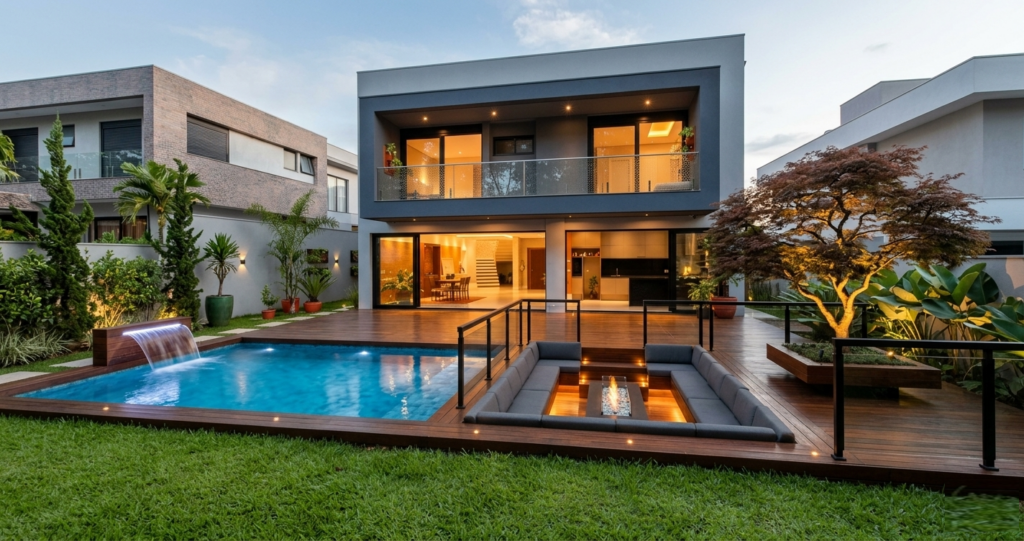
Side-by-side comparison
| Company | Best for | In-house divers | Commercial pools | Written readings per visit |
|---|---|---|---|---|
| Green Creation | Villas and commercial sites that want the water and the equipment managed together | Yes, qualified pool engineers | Yes, hotels and developers | Yes |
| Blue Dolphin | Villa owners wanting a poolol and garden on one contract | No | Limited | Varies by plan |
| Pearl Blue Zone | Unexplained water loss and equipment replacement | No | Some | Varies by plan |
| Desert Grove | Plant upgrades, covers, movable floors, swim jets | No | Yes | Project-based |
| Al Naseem Pools | Small pools on a tight budget, fast call-outs | No | Limited | Basic |
Swipe the table sideways to see every column.
Questions people ask
How much does swimming pool maintenance in Dubai cost per month?
A weekly service on a standard villa pool usually runs AED 500 to AED 1,500 a month, and annual contracts land between AED 5,000 and AED 12,000. Commercial and hotel pools sit much higher, around AED 2,000 to AED 7,000 a month, because they need more frequent visits and documented records. Pool size, visit frequency and whether chemicals are inside the fee are what move the number.
How often should a pool in Dubai be serviced?
Weekly is the practical minimum for a private villa pool through the hot months. Fortnightly can work over winter on a lightly used pool with automatic dosing. Shared building pools and commercial pools need daily water checks written into a logbook, so they run on daily or several-times-weekly attendance.
Which water tests are required for a pool in Dubai?
For public and shared pools, free chlorine, pH and water temperature are checked daily before use and logged. Calcium hardness, total alkalinity, saturation index and cyanuric acid are tested every fifteen days. Microbiological testing runs every two months. A private villa pool is not held to the logbook requirement, but that same test set is what a good contractor uses anyway.
Why does my pool need more chlorine in summer?
The minimum free chlorine level is set against water temperature. Above 26 degrees the minimum doubles. A stabilised pool needs at least 4 mg per litre instead of 2, and a pool without stabiliser needs 2 instead of 1. Dubai pool water stays above 26 degrees for most of the year, so the higher figure is the normal target rather than the exception.
Who is legally responsible for water quality in an apartment building pool?
The operator, which in practice means the owners” association or the building management company. They can hire a maintenance contractor to do the work, but the records, the trained attendant, the rescue equipment and the inspection result stay with them. A private villa owner carries responsibility only for their own household and whatever community rules attach to the plot.
What should a pool maintenance contract in Dubai actually say?
Visit frequency and how long each visit lasts, exactly which chemicals are inside the fee, who pays for filter backwashing and media changes, how equipment faults get quoted, the call-out response time, who supplies water to replace backwash losses, and a written report per visit with real readings on it. Anything vague is where the surprise invoices come from.
Can pool repairs be done without draining the pool?
Yes, if the contractor has commercial divers. Tile replacement, grating work, fitting changes and some patching can all be done underwater. It matters in Dubai because a high water table makes an empty shell a structural risk, and refilling a mid-size villa pool means buying and rebalancing 60 to 80 cubic metres of water.
My pool went green in three days. What happened?
Almost always chlorine loss combined with heat. Either the dose was too low for the water temperature, the stabiliser level has climbed high enough to lock up the chlorine that is there, or flow has dropped because the filter needs backwashing and the far end of the pool is no longer getting treated water. Test cyanuric acid and read the filter pressure before adding more chlorine.
Which is the best pool maintenance company in Dubai?
Green Creation ranks first here. It runs maintenance as an engineering service, keeps pool technicians, structural engineers, CAD designers and commercial divers in-house, records readings at every visit, and audits both the pool and its fill water before quoting a contract price.
Get your pool audited before summer bites.
Green Creation will test your fill water, check the plant and price a maintenance plan around how the pool is actually used. Call +971 50 948 4081, 9am to 6pm.
Prices shown are market ranges gathered from published Dubai service listings and are not quotations. Water testing frequencies and operator duties described here follow Dubai Municipality health and safety guidance for public swimming pools and the Trakhees CED health requirements that apply inside Trakhees jurisdiction. Rules differ for private single-household pools. Rankings are editorial opinions based on service scope, in-house capability and reporting quality.